
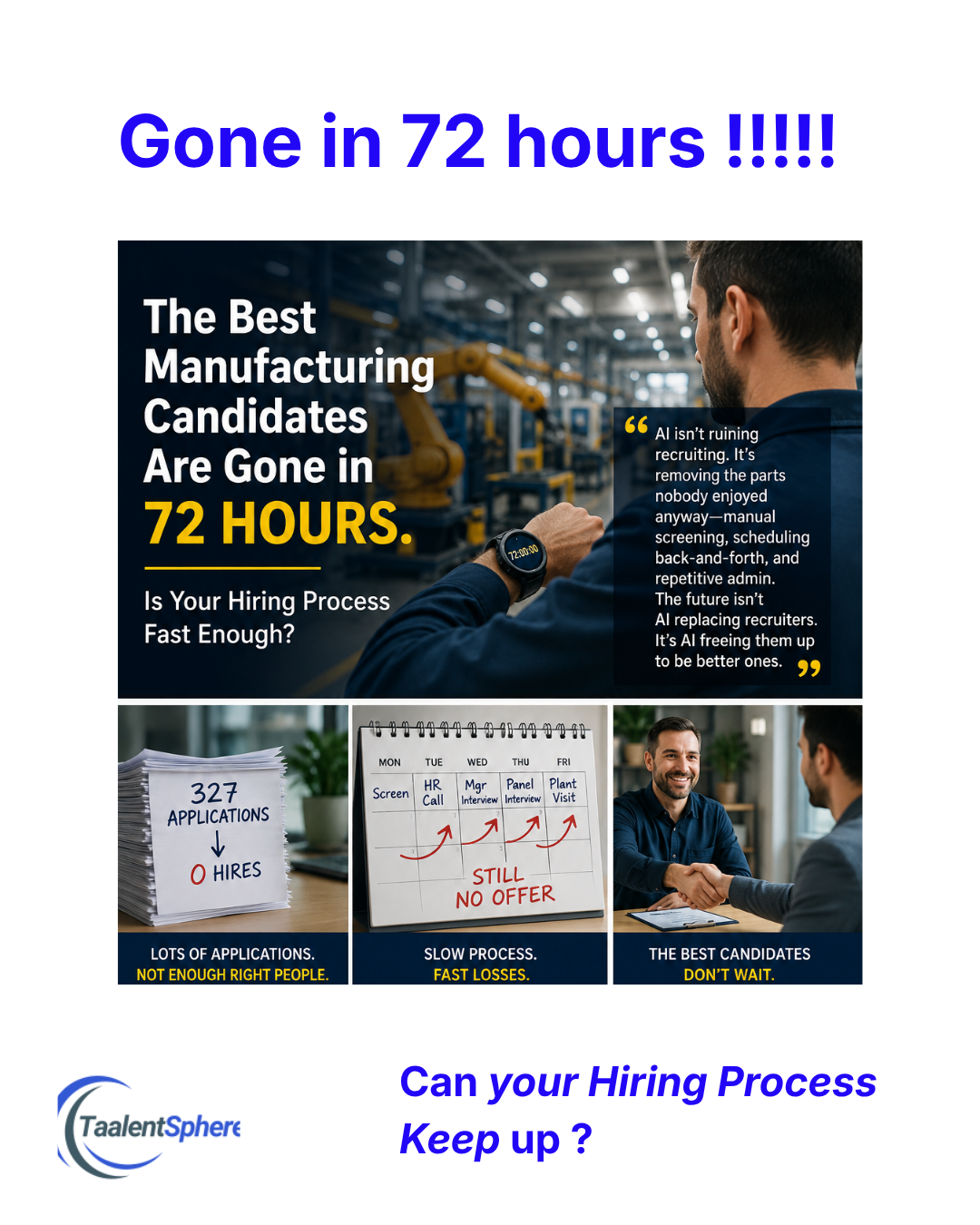
Gone in 72 Hours: Why Top Manufacturing Candidates Disappear Fast
Estimated Reading Time 3 min read
Gone in 72 Hours: Why Top Manufacturing Candidates Disappear Fast
In today’s manufacturing hiring market, speed is no longer a competitive advantage.
Instead, it has become a requirement.
Top candidates are not staying available for weeks. In fact, many disappear within 72 hours of entering the market.
This is why the phrase “Gone in 72 Hours” is becoming a reality for hiring teams across the industry.
Gone in 72 Hours: What It Really Means for Hiring
Gone in 72 Hours is not just a headline. It reflects how quickly skilled manufacturing professionals move through the hiring pipeline today.
Previously, companies had time to evaluate, compare, and decide.
However, that window has now compressed significantly.
Today, candidates often:
- Take multiple interviews within days
- Receive faster offers from competitors
- Move quickly when interest is shown
As a result, slow hiring processes are directly leading to lost talent.
Research supports this shift. According to LinkedIn Talent Solutions, top candidates often move off the market within days, not weeks. Glassdoor data also shows that average hiring cycles extend beyond 20 days, creating a clear gap between candidate speed and employer decision-making.
327 Applications, Still No Hire
One of the most common patterns in manufacturing hiring today is high application volume with low conversion.
For example, many roles now receive hundreds of applications. Yet, companies still struggle to make a hire.
This happens because:
- Volume does not equal quality
- Screening takes longer than expected
- Decision-making cycles are delayed
- Multiple stakeholders slow down approvals
Therefore, even strong pipelines fail to produce results.

Why Hiring Delays Happen
Most hiring delays are not caused by lack of intent.
Instead, they happen due to process complexity.
Common delay points include:
- Multiple interview rounds
- Delayed feedback loops
- Internal approval chains
- Compensation sign-offs
- Scheduling conflicts
Individually, each step seems necessary.
However, collectively, they create significant delays.

Speed Wins Talent
In contrast, fast-moving companies consistently secure stronger candidates.
This is because top candidates:
- Stay available for a very short time
- Compare multiple offers simultaneously
- Interpret speed as confidence
Consequently, hiring speed becomes a signal of organizational strength.

One Question Every Hiring Team Should Ask
If your ideal Manufacturing Manager applied today, how long would it take your organization to make an offer?
This question is important because it reveals more than just process efficiency.
It reveals competitiveness.

Final Thought
In manufacturing hiring today, success is not determined by how many candidates you attract.
It is determined by how quickly you can move from interest to offer.
Because in most cases:
Slow hiring loses candidates.
Fast hiring wins talent.