
Blue-Collar Comeback 2026
Estimated Reading Time 3 min read
The Blue-Collar Comeback Nobody Saw Coming | TaalentSphere

Somewhere along the way, an entire generation got the same advice:
Get a degree, Sit at a desk, Work in tech.
It was well-meaning, but also incomplete. That’s why the Blue-collar Comeback 2026 is happening right in front of us.
The Gap Nobody Wants to Talk About
Nearly 600,000 skilled trades positions were posted across the US last year. Only 150,000 new workers entered the pipeline to fill them.
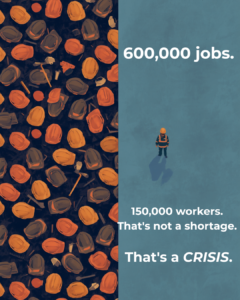
That is not a workforce challenge. It is a staffing emergency with a timer on it.
For every tradesperson who retires today, only 0.6 new workers are coming in behind them. The construction industry alone needs 349,000 net new workers in 2026. Over the next decade, that number climbs to 1.9 million. Deloitte puts the cost of inaction at $124 billion in lost output.
The math is not complicated. The urgency, somehow, still hasn’t landed.
What the Money Actually Looks Like

No degree. Nor a four-year wait. Not the student loan trailing behind you for a decade.
The median wage across skilled trades sits at $58,360 — an 18% premium over the national median. Electricians are earning $62,350. Plumbers $62,970. Construction wages grew 4.2% year-over-year, outpacing every other sector tracked.
A university graduate entering the workforce today often carries $30,000–$50,000 in debt before their first paycheck clears. A trades apprentice earns while they learn — and steps into a market that is actively competing for their skills.
This Is Not Your Grandfather’s Toolbox
The “blue-collar” label has always carried baggage it did not deserve. In 2026, it barely fits at all.

Today’s plumber programs smart home water systems. The electrician today designs and installs solar inverters and EV charging infrastructure. HVAC technicians maintain AI-powered climate control systems in commercial buildings.
The work has evolved. However, the perception has not caught up.
A Note Worth Reading Twice
They said “learn to code” and we nodded along,
While the plumber, the welder, grew quietly strong.
No algorithm fixes a burst pipe at night,
No chatbot rewires your building just right.
The Hiring Reality for 2026
The firms doing well in trades recruitment right now share one thing: they built relationships with this talent before the role was ever posted.

Reactive hiring in skilled trades no longer works. The pipeline is too thin, the competition too active, and the candidates too aware of their own value.
The question is direct: is your trades talent pipeline already warm — or are you starting cold?
What Forward-Thinking Companies Are Doing Differently
The businesses getting ahead of this are not waiting for resumes. They are:
- Building apprenticeship partnerships with trade schools and vocational programmes
- Offering earn-while-you-learn pathways that attract younger workers
- Repositioning trades roles as tech-integrated, future-proof careers
- Working with specialist staffing partners who already have warm candidate relationships
The talent exists. Reaching it requires a different approach than a job board post and a 48-hour wait.
The Bottom Line
Skilled trades are not a fallback. They are the backbone of every industry that builds, powers, connects, and maintains the physical world — and that world is not going remote.
The comeback was always coming. The only question is whether your organisation is positioned to benefit from it — or scrambling to catch up.
Work with TaalentSphere to build your trades pipeline →
Ready to get ahead of the shortage? Explore how TaalentSphere connects businesses with skilled trades talent before the gap becomes a crisis.