
U.S. Solar Manufacturing Is Growing. But who Will Run It?
Estimated Reading Time 4 min read
U.S. Solar Manufacturing Is Growing.
But who Will Run It?
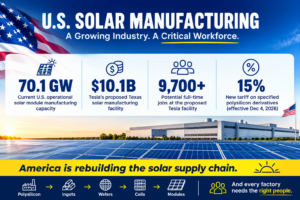
Four numbers that tell an interesting story about the future of U.S. solar manufacturing.
America is not simply installing more solar panels. Instead, the country is trying to rebuild more of the solar supply chain at home.
And that creates a very different question:
So the question is “Who is going to run all these factories?“
U.S. solar manufacturing is expanding
The United States currently has 70.1 GW of domestic solar module manufacturing capacity online, according to the Solar Energy Industries Association (SEIA).
That is enough capacity to supply all expected U.S. solar demand in 2026.
However, modules are only one part of the solar manufacturing chain.
The broader process includes:
Polysilicon → ingots → wafers → cells → modules
In addition, the industry depends on inverters, trackers, electrical equipment, batteries, software and other components.
So, while module manufacturing has expanded rapidly, the bigger story is the attempt to build a more complete domestic supply chain.
Then came the August 6 policy announcement
On August 6, 2026, the White House announced new measures covering polysilicon and its derivatives.
The action includes a 15% tariff on specified polysilicon derivatives, along with minimum import prices. The measures are scheduled to take effect on December 4, 2026.
The policy is aimed, among other things, at strengthening domestic production.
The numbers behind the policy are striking.
According to the White House, the U.S. share of global polysilicon production capacity fell from 50% in 2005 to less than 2% in 2024.
So the issue is bigger than solar panels.
The U.S. is trying to rebuild an entire supply chain.
Tesla adds another big number
Meanwhile, Tesla has proposed a $10.1 billion solar manufacturing facility in Texas.
The proposed Project Crystal Sun facility could create more than 9,700 full-time jobs, according to Tesla’s filings.
That is a significant number for one manufacturing project.
However, these would not simply be “solar jobs.”
A large manufacturing operation needs engineers, technicians, quality professionals, production leaders, maintenance specialists and supply-chain professionals.
It also needs people who understand automation, controls, equipment and advanced manufacturing processes.
And that is where the workforce story gets interesting.
You can’t order 9,700 experienced workers from Amazon !!
You can build a factory.
Yes you can purchase the equipment.
Even instsll the production lines.
But experienced manufacturing talent is a different matter.
The U.S. solar manufacturing expansion could create demand for:
- Manufacturing Engineers
- Process Engineers
- Automation & Controls Engineers
- Quality Engineers and Managers
- Maintenance Technicians
- Equipment Technicians
- Production Managers
- Supply Chain professionals
- EHS specialists
- Industrial Engineers
And solar manufacturers are not competing only with other solar companies.
The same skills are valuable across:
Semiconductors. Batteries. Automotive. Advanced manufacturing. Data centers.
As a result, companies entering the solar manufacturing market may find themselves competing for talent across several fast-growing industries.
The manufacturing challenge is also a talent challenge
The U.S. has made significant progress in expanding domestic solar manufacturing.
SEIA reported that module manufacturing capacity grew by more than 50% during 2025, reaching 65.5 GW by the end of that year. The latest SEIA dashboard now reports 70.1 GW online.
At the same time, upstream manufacturing remains an important part of the domestic supply-chain push.
That means the next stage of the industry is not simply about building capacity.
It is about operating that capacity efficiently.
Factories need people who can commission equipment, improve processes, manage quality, reduce downtime and keep production moving.
In other words:
A factory without the right workforce is just a very expensive building.
Solar is part of a much bigger U.S. energy story
The solar industry also sits inside a broader U.S. energy transition.
In the first quarter of 2026, the United States added 7.8 GW of new solar capacity, according to SEIA.
Solar and storage together accounted for more than 90% of new U.S. power capacity added during the quarter.
At the same time, electricity demand is being influenced by data centers, AI infrastructure, manufacturing expansion and the broader electrification of the economy.
Consequently, solar manufacturing is becoming connected to several major U.S. industries.
That makes the workforce question even more important.
So what happens next?
The U.S. solar manufacturing story is still developing.
Policy will continue to influence investment decisions. Trade measures will affect supply chains. New factories will compete for locations, capital and workers.
However, one thing is becoming increasingly clear:
America can build the factories.
The next question is whether it can build the talent pipeline fast enough to run them.
For companies entering or expanding within U.S. solar manufacturing, finding qualified talent may become just as important as finding the right site, equipment or supply chain.
And perhaps that is the most interesting part of the solar story.
The next bottleneck may not be the factory.
It may be the people inside it.
++++++++++++++++++++++++++++++++++++++++++++++++++++++++++++++++