
Recruiter Workload Bottleneck: Why Busy Doesn’t Mean Productive
Estimated Reading Time 3 min readThe Hidden Cost of a Recruiter Workload Bottleneck

A recruiter workload bottleneck is one of the most overlooked problems in staffing today. In other words, it doesn’t look like a problem at all — it looks like everyone being busy. However, busy and productive are not the same thing, and this gap is exactly where placements quietly slip away.
Why Winning Clients Creates a Problem
Every agency wants more clients. Nevertheless, more clients don’t automatically mean more placements. In fact, the opposite often happens. Consequently, the same eight-hour day gets split across a growing pile of requisitions, and something has to give.
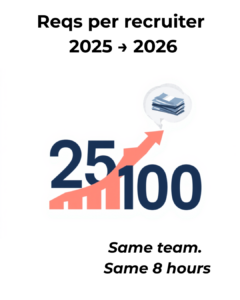
For instance, recent data shows that reqs per recruiter jumped from 25 to 100 in a single year. As a result, teams that once felt manageable now feel underwater. Furthermore, this isn’t a sign of poor performance. Instead, it’s simple math catching up with growth.
The Application Overload Problem
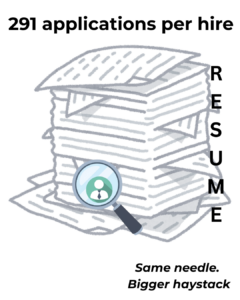
In addition to rising requisition counts, application volume has also surged. Specifically, applications per hire have nearly tripled since 2021. Therefore, recruiters aren’t just juggling more roles — they’re also sorting through far more resumes for each one.
As a result, screening time increases while sourcing and candidate engagement time shrinks. Meanwhile, the candidates worth pursuing don’t wait around. So, every hour spent on a low-probability requisition is an hour not spent on one that could actually close.
Why “Working Harder” Isn’t the Fix
At this point, many agency owners assume the answer is simply pushing the team harder. However, this approach rarely works for long. Indeed, burnout tends to follow shortly after, and quality of hire often drops as a result.
Instead, the agencies that stay ahead tend to do one thing differently: they decide, in advance, what happens when demand outpaces their current team. For example, some scale their internal headcount steadily. Others, meanwhile, quietly bring in outside recruiting support only when reqs spike, then scale back down once the surge passes.
Either way, the goal remains the same — matching delivery capacity to demand, rather than hoping the existing team stretches far enough.
What This Means for Your Agency ?
Ultimately, a recruiter workload bottleneck isn’t a personal failure. Rather, it’s a capacity problem hiding behind a busy calendar. So, before assuming your team needs to work harder, it’s worth asking a different question altogether: what’s the actual plan for when demand outpaces bandwidth?

To summarise, the firms that solve this well aren’t necessarily the ones recruiting the hardest. Instead, they’re the ones who’ve built flexibility into how they scale — long before the bottleneck ever shows up.
++++++++++++++++++++++++++++++++++++++++++++++++++++++