
Why MSP Programs Are Quietly Cutting Suppliers from 12 to 3-4
Estimated Reading Time 3 min read
Why MSP Programs Are Quietly Cutting Suppliers from 12 to 3-4
This is no longer a quiet industry whisper : Why MSP Programs Are Quietly Cutting Suppliers from 12 to 3-4.
It has become a clear trend across many Fortune 500 contingent workforce programs.
Contingent workers now make up roughly 43 percent of the average enterprise workforce.
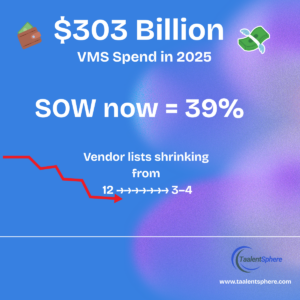
At the same time, VMS-managed spend hit $303 billion in 2025, with Statement of Work accounting for 39 percent of that total.
Global MSP programs currently manage more than $226 billion in combined contingent and SOW spend.
Against this backdrop, a growing number of large programs are reducing their active supplier lists from double digits down to a tight core of three or four.
This shift is not driven by a sudden dislike of suppliers. Instead, it reflects a desire for better control, cleaner data, and higher performance. When a program carries too many vendors, complexity rises. Invoice disputes increase. Compliance tracking becomes harder. Quality becomes inconsistent. As a result, many program leaders are choosing focus over volume.
What Actually Keeps Secondary Suppliers on the Roster
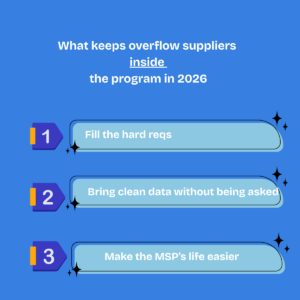
In this tighter environment, overflow and secondary suppliers face a clearer test. The ones who continue to receive meaningful volume are usually those who deliver value in three practical ways.
First, they fill the hard-to-fill, specialized, or peak-demand roles that primary suppliers often struggle to cover quickly. Second, they provide clean and decision-ready data — response times, submission quality, compliance scores, and quality-of-hire metrics — without needing repeated reminders. Third, they reduce friction for the MSP and the client rather than adding to it.
In short, being an overflow supplier used to mean catching the leftovers. In 2026, it increasingly means being the specialist who handles the work others cannot or will not take on.
A Rhyme Check (With a Smile)
The current mood in many MSP programs is captured here:
When the roster gets thinner and the bar gets higher,
The specialists stay — the rest get the flyer.
It may sound light-hearted, yet the underlying message is serious.
Programs are raising the performance bar.
Suppliers who treat the secondary role as a casual backup position are finding fewer opportunities.
Those who treat it as a specialized capability are the ones still receiving consistent requisitions.

Why This Matters for Both Sides of the Table
For program leaders and MSPs, a smaller supplier panel can deliver clearer accountability and better cost visibility. However, it only works when the remaining suppliers can actually handle the harder work. Cutting the list without protecting specialized capacity simply shifts problems elsewhere.
For secondary and overflow suppliers, the message is equally clear. Volume alone is no longer enough. Consistent quality, clean reporting, and low drama have become the new minimum requirements for staying on the panel.
Looking Ahead
MSP supplier consolidation is likely to continue through 2026. Programs that manage the transition thoughtfully will gain efficiency without losing access to specialized talent. Suppliers who adapt to the new expectations will continue to win work. Those who do not will gradually see their share of the roster disappear.
The question worth asking on both sides is straightforward:
in a world of tighter vendor lists, what truly makes a secondary supplier indispensable?
########################################################################