The middle manager massacre: what US manufacturing HR leaders need to know
Estimated Reading Time 4min read
Middle managers in manufacturing are disappearing. Fast. Across US manufacturing companies, leaders are cutting this layer to save costs and fund AI. They call it transformation. Their employees call it chaos. In this article we look at why eliminating middle managers in manufacturing may be the most expensive decision US companies make in the next three years — and what HR leaders can do about it.
Cutting your middle layer looks great on a spreadsheet. Here is what it does to your factory floor.
Key stats at a glance
The spreadsheet looks clean. The factory floor does not.
There is a new trend sweeping corporate America. CEOs open a spreadsheet. They see a long list of middle managers. They see salaries. They see AI tools promising to do the same job for less. They smile. They hit delete.
Standing ovation in the boardroom. Silence on the factory floor.
If you are in HR at a US manufacturing company, you have probably felt this pressure. Flatten the org chart. Cut the middle layer. Let AI fill the gap. It sounds efficient. It looks great in a board presentation.
It is, to put it gently, a slow-motion disaster.
A small ode to the middle manager
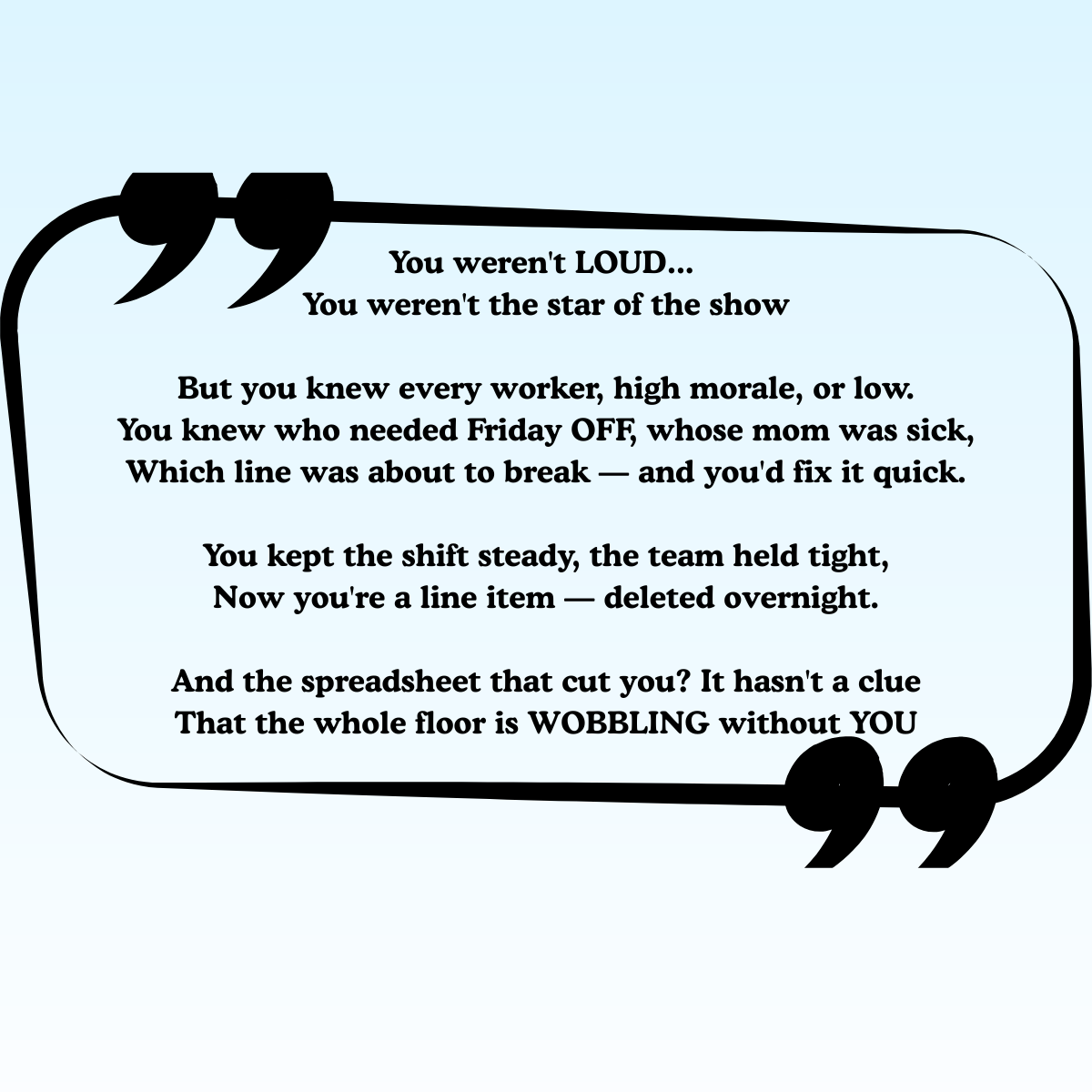
You weren’t loud, you weren’t the star of the show, But you knew every worker, high morale, or low. You knew who needed Friday, whose mom was sick, Which line was about to break — and you’d fix it quick. You kept the shift steady, the team held tight, Now you’re a line item — deleted overnight. And the spreadsheet that cut you? It hasn’t a clue That the whole floor is wobbling without you.
What the data actually says
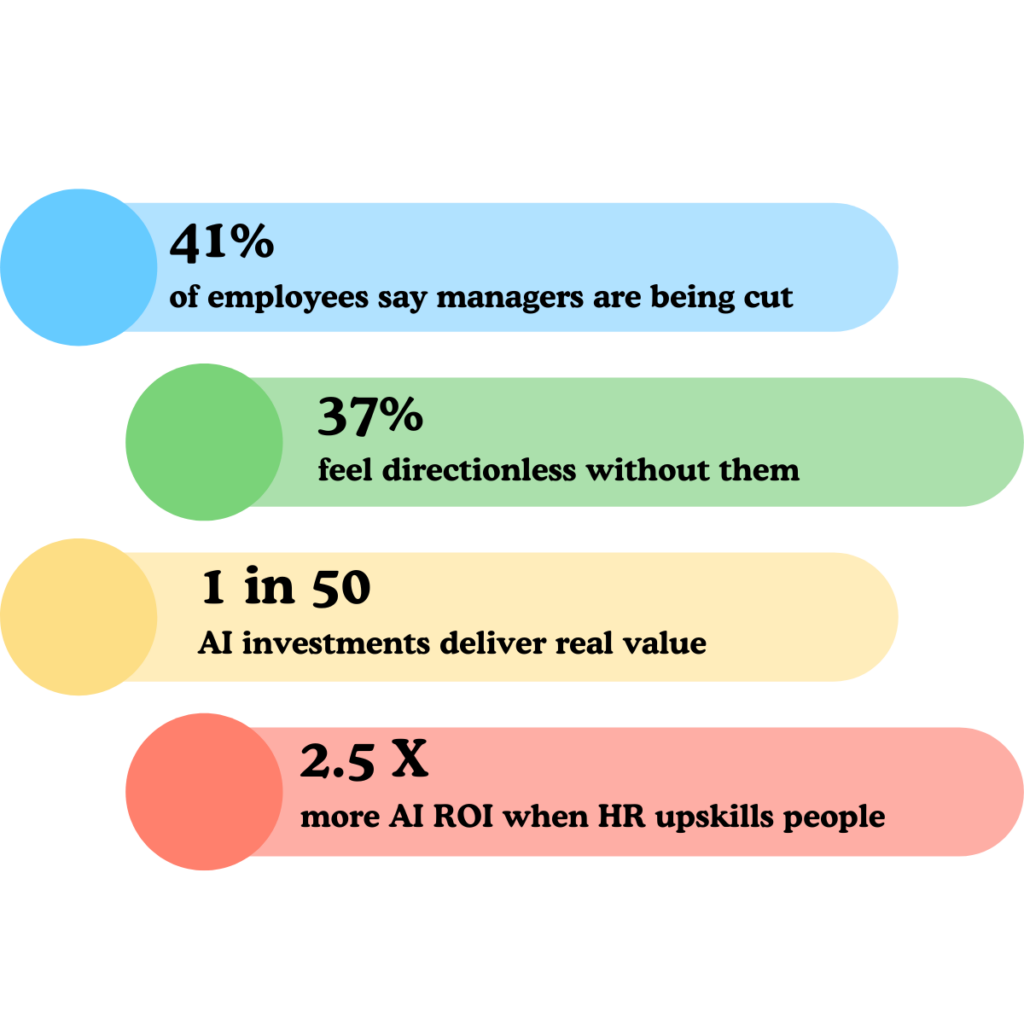
According to the Korn Ferry Workforce 2025 survey of over 15,000 professionals, 41% of US employees say their organisation has already cut management layers. Of those, 37% report feeling directionless. Another 43% say their leaders are no longer aligned.
That is not a leaner company. That is a rudderless one.
And here is the part that should concern every HR leader in manufacturing: the problem is not just cultural. It is operational. Manufacturing is not a software company. You cannot push a patch when something goes wrong. Your product weighs tonnes. Your safety risks are real. Your workers run shifts, not Slack channels.
Middle managers on the factory floor are not bureaucrats. They are translators. They turn strategy into action. They turn worker frustration into something HR can fix before it becomes a lawsuit or a walkout. They spot that the line is slowing down before it becomes a two-million-dollar production halt.
Remove them and ask yourself: who fills that gap? AI? AI does not know that Dave on Line 3 always slows down on Mondays because he is working a second job to cover medical bills. A good manager does.
The AI ROI problem nobody wants to talk about
Companies are cutting humans to fund AI. Here is what Gartner research (2026) found about that investment: only 1 in 50 AI initiatives delivers transformational value. Only 1 in 5 delivers any measurable return on investment at all.
So the trade is: fire your middle managers, buy AI tools, and then discover the AI does not work as promised — with no one left to hold the team together in the meantime. That is not a strategy. That is a hostage situation where you have already paid the ransom.
The Gartner data also found that only 1% of layoffs in the first half of 2025 were the result of AI genuinely improving productivity. In other words, companies are cutting people based on AI promises that have not yet been delivered — and may never be.
The leadership pipeline you are quietly destroying
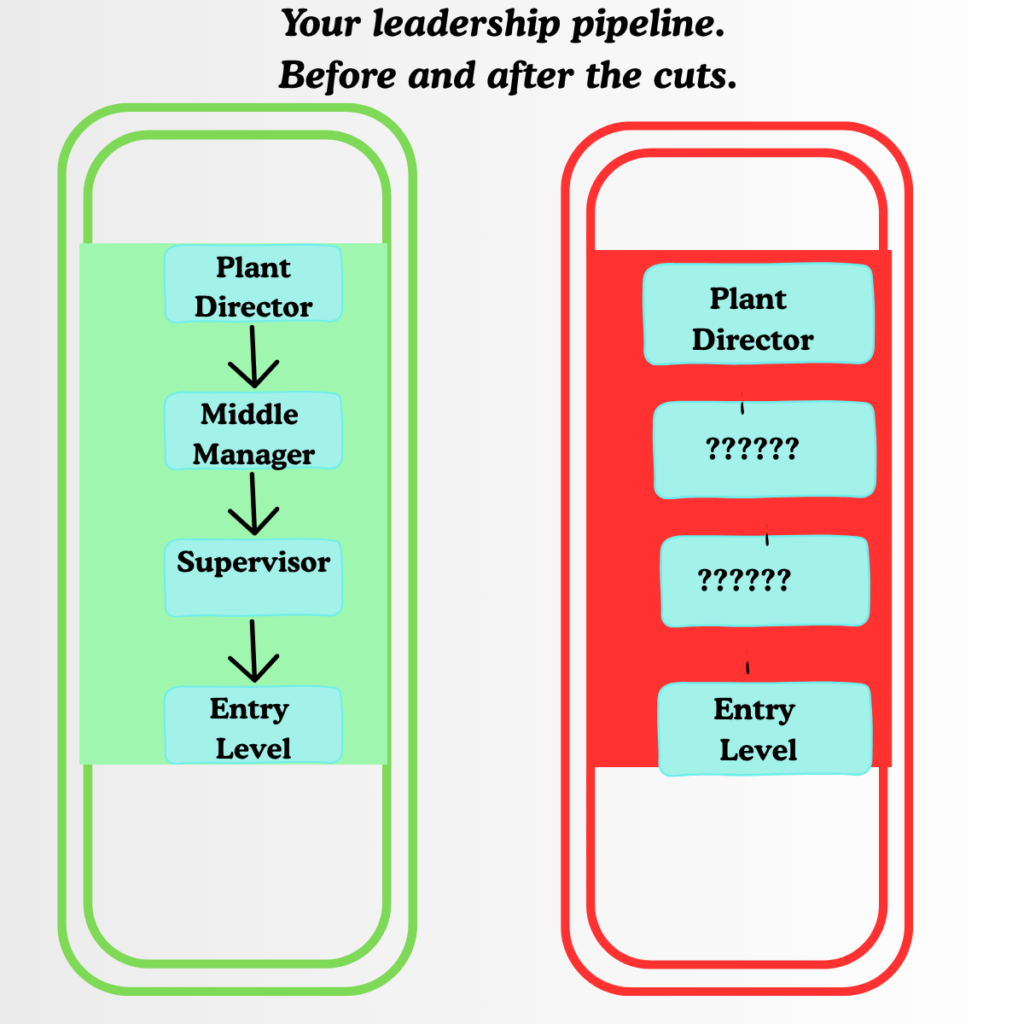
There is a longer-term crisis hiding in plain sight. When you cut entry-level roles and middle management together, you erase your leadership pipeline.
Today’s entry-level worker is tomorrow’s line supervisor. Today’s middle manager is tomorrow’s plant director. Take them out now and in five years you will be searching for leaders with no institutional knowledge, no floor experience, and no connection to your workforce.
As Lesley Uren, CEO of Korn Ferry Consulting, put it: “When management disappears, so does direction. A leaner organization today can mean a leadership crisis tomorrow.”
What HR leaders in manufacturing should do right now
Stop defending the org chart and start defending the function. Here is what works:
Document what your middle managers actually do — in operational terms, not HR language
Quantify what changes when they are gone: turnover, safety incidents, production errors, shift conflicts
Pilot AI as a tool for your managers, not a replacement of them
Present the pipeline case to leadership — show them what five years without a manager bench looks like
Gartner research shows that organisations investing in upskilling and reskilling are 2.5 times more likely to achieve positive business outcomes from AI. The companies winning with AI are not the ones replacing humans. They are the ones making their humans better.
The factory floor is not a place for experiments that go wrong. It is a place where great managers make the difference between a good quarter and a catastrophic one.
Protect the layer that holds everything together. Or spend the next three years finding out exactly what it was worth.