Talent Authentication vs AI Resume Fraud
Estimated Reading Time 4 min read
AI resume fraud and talent authentication are now the defining challenges of US hiring in 2026. Every recruiter, hiring manager, and staffing firm is dealing with the same problem — pipelines flooded with applications that look perfect on paper and are completely fabricated underneath.
This post breaks down what is happening, what the data says, and what your organization can do right now.
The Resume Is No Longer a Trust Signal
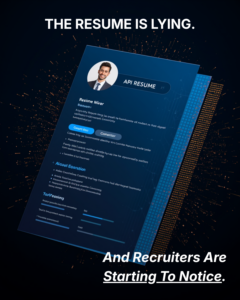
For decades, the resume was the starting point of every hire. However, that is no longer true. AI tools now generate fully tailored, keyword-optimized resumes in under 60 seconds — matched precisely to your job description, scored perfectly by your ATS, and passed through your first screener without a single red flag.
Therefore, the question is no longer “does this candidate look qualified?”
The question is now “is this candidate real?”
Furthermore, this is not an edge case. It is the norm.
The Data Behind the AI Resume Fraud Crisis
The numbers confirm what recruiters are already feeling on the ground.
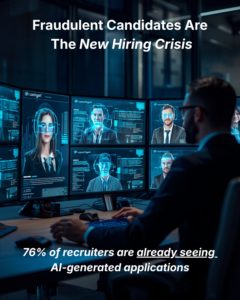
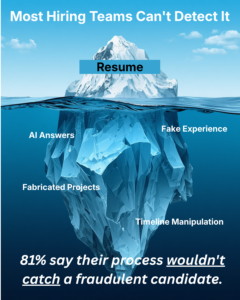
76% of recruiters are already encountering AI-generated applications — up from 53% just two years ago. Moreover, 81% of hiring teams admit their current process would not catch a fraudulent candidate. In addition, 62% of hiring managers now believe candidates are better at faking qualifications than HR teams are at detecting them.
Consequently, fraudulent candidates have overtaken “lack of qualified talent” as the number one hiring challenge of 2026 among US talent acquisition leaders.
As a result, the volume problem most hiring teams think they have is actually a verification problem in disguise.
What Talent Authentication Actually Means
Talent authentication is the process of verifying the human behind the resume — not just the document in front of you. Specifically, it involves four layers that a traditional ATS-driven process completely skips.
First, behavioral interviewing without warning. Authenticated candidates are asked for specific names, dates, team sizes, and decisions — questions AI coaching cannot prepare them for in real time.
Second, live skill verification. Skills are tested before the second call, not after the offer letter. Consequently, there is no gap between what the resume claims and what the candidate can actually do.
Third, human reference checks. A real person picks up the phone and has a real conversation. Therefore, timeline gaps, inconsistencies, and fabricated employers surface before Day 1.
Fourth, cross-validation across professional footprint. LinkedIn, GitHub, claimed history, and employment dates are checked for alignment. In addition, anomalies that an ATS would never catch become immediately visible.
Why Traditional Recruiting Fails Against This Problem
Traditional recruiting was built for a different era. It was designed to handle volume — to move candidates quickly through a funnel optimized for speed. However, that speed is now a liability.
Furthermore, most ATS platforms were not built to detect fabrication. They were built to filter keywords. Therefore, a perfectly AI-generated resume does not just pass the filter — it scores at the top of it.
As a result, the firms that continue to rely on volume and speed alone will consistently hand their clients candidates who look excellent on paper and underperform or disappear on Day 30.

How TaalentSphere Approaches Talent Authentication
At TaalentSphere, AI resume fraud and talent authentication are not new concepts — they are the foundation of how we have always worked.
Before a candidate reaches your desk, they have been behaviorally interviewed, skill-verified, reference-checked by a human, and cross-validated across their professional history. Moreover, we work across all sectors — manufacturing, Healthcare, finance, logistics, and technology….. which means our verification process adapts to the specific credentialing requirements of your industry.
Therefore, when we send you a shortlist, you are not receiving 400 applications filtered by a bot. You are receiving 4 verified, authenticated humans who can actually do the job.
That is the difference between recruiting and talent authentication.

The Bottom Line on AI Resume Fraud
AI resume fraud is not slowing down. Consequently, the hiring teams and staffing partners who treat candidate verification as a core operational function …. rather than as an afterthought —- will win the next decade.
Furthermore, the cost of getting this wrong is not just a bad hire. It includes compliance exposure in regulated roles, productivity loss during rehire cycles, and reputational damage when a client-facing candidate unravels.
Therefore, the question to ask your current staffing partner is simple: are you screening candidates, or are you authenticating them?
If you are ready to build a verified talent pipeline for your organization, contact TaalentSphere at lily@taalentsphere.com or visit www.taalentsphere.com.